


Bringing Missing Relatives Home: The Coordinators Fighting the MMIR Crisis
By Kyler Edsitty
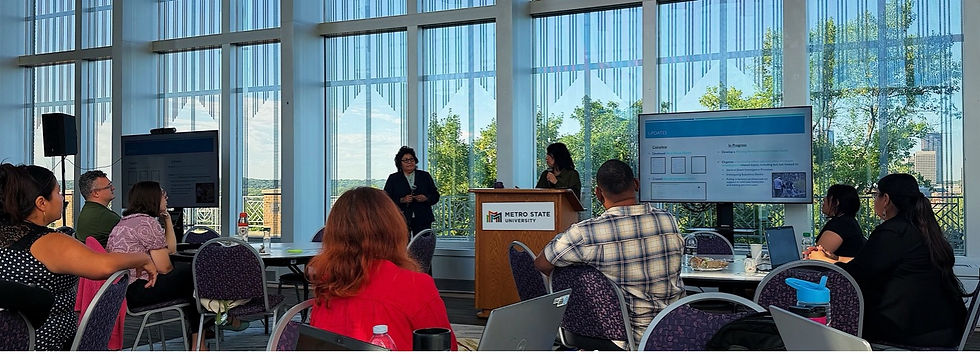
[St. Paul, MN – September 9, 2026] – In 2024, there were 10,248 Missing American Indian and Alaska Native Person entries into the National Crime Information Center (NCIC). That is nearly 11% of all 93,447 NCIC entries in 2024, although Native American populations make up only 3% of the United States population. However, these are only the cases entered into the NCIC. Many cases are left uncounted, uninvestigated, and unresolved. That leaves hundreds of Native families still searching and still seeking answers, with the hope that their loved ones return home. These are the alarming numbers behind the Missing and Murdered Indigenous Relatives (MMIR) epidemic.
With so many cases and questions lingering, there are many people dedicated to supporting families through the trauma of missing a loved one. MMIR coordinators work alongside families and law enforcement to resolve these missing-person cases. In addition to serving as liaisons, they provide crisis response directly to families at the time of a disappearance and do community outreach and raise awareness of the MMIR crisis.
This network of MMIR coordinators is extremely important to nurture and cultivate as they work on troubling cases and provide emotional support.
The Minnesota Department of Public Safety hosted a National MMIP Coordinators Gathering to help professionals working to address the MMIP epidemic across the country connect. Other attendees included first responders, search and rescue teams, and MMIR organizations, who shared knowledge and best practices. During the gathering, the coordinators participated in learning sessions that focused on case studies, policy changes, and the latest MMIR data collection. More importantly, the gathering restated the importance of MMIR Coordinators and the work they do to bring comfort to families behind the scenes.
Regina Begay-Roanhorse is the Southwest MMIP Coordinator and works under the U.S. Department of Justice. As the Southwest Coordinator, she works to connect federal resources with state and tribal representatives and raise awareness of available tools.
Begay-Roanhorse spoke to the importance of the gathering and how it benefits MMIR coordinators in addressing the MMIR crisis.
“These meetings are vital for sharing information, strengthening contacts and relationships, and addressing emerging challenges with state, tribal, federal, and community partners,” Begay-Roanhorse stated.
Native Public Media (NPM), an Arizona-based nonprofit organization, participated in a panel to discuss evolving alerting systems used to notify the public about a missing individual. NPM spearheaded the Missing and Endangered Persons (MEP) Alert, which was designed to alert the public about a missing person, regardless of race, through the Integrated Public Alert Warning System (IPAWS). IPAWS is the national emergency alert system that was created for the President of the United States to issue an emergency alert nationwide. Emergency alerts are issued through radio, television, and cell phones.
In the panel, NPM emphasized the need for standardized and consistent MEP Alert guidelines or qualifications for activation across Tribal jurisdictions and states. These guidelines include activating the Alert for any person, adult or minor, individuals at risk of serious harm, and cases with enough descriptive information about the individual or suspect.
The qualifying guidelines work alongside an additional consistent activation process for the MEP Alert. This includes law enforcement determining the case meets the Alert guidelines, entering the case into the NCIC, broadcasting the Alert, and continuous training for law enforcement and first responders.
These standardized guidelines across different jurisdictions eliminate delays and ensure the public receives a fast, coordinated response regardless of where someone goes missing.
This process can be even more effective when federally recognized Tribes implement IPAWS in their communities and become an Alerting Authority, an authorized entity allowed to create and broadcast public safety Alerts. When Tribes become Alerting Authorities, they take ownership of their public alerting capabilities and allow alerts to disseminate faster.
Presenting the MEP Alert and NPM’s recommended guidelines to MMIR Coordinators is extremely important because it informs them about available immediate alerting opportunities for families and how individual cases qualify for alerts. It also allows Coordinators to work alongside law enforcement to ensure these alerts are not only available but are also being disseminated when it matters most.
The MMIR epidemic continues to demand urgent action, collaboration, and sustained support for Native families. While MMIR coordinators work to strengthen communication, improve case response, and raise awareness of the crisis, the continued number of missing Indigenous people demonstrates that more work remains to be done. Behind these statistics are families and communities navigating uncertainty, loss, and the search for answers. MMIR coordinators play a critical role in supporting these families and connecting them with the resources and response systems they need. Gatherings like this provide an important opportunity for coordinators to connect with first responders, nonprofit organizations, and others working in the field to share knowledge, strengthen partnerships, and identify ways to improve the response to MMIR cases. Addressing this crisis requires a sustained commitment to ensuring that every missing person is seen, every family is supported, and every loved one has a path toward answers.
“On behalf of the Department of Justice, it was an honor to attend the National Missing and Murdered Indigenous Peoples Gathering in St. Paul, Minnesota,” Begay-Roanhorse stated. “The Department recognizes the significant challenges facing tribal communities as they experience violent crime. We express our solidarity with victims and survivors and remain committed to advancing justice in Indian Country for all.”
XXX
This deserves so much more attention. Families need answers, and they need people willing to stand beside them. @acceleration city
The content was truly engaging and informative. I sincerely appreciate you for sharing such valuable insights. You made an excellent point, and I completely agree with your perspective. Thank you for contributing this helpful information. Leon Kennedy Jacket
I really enjoyed reading this content. Thank you for providing such unique and useful information. Your point of view is excellent, and I fully agree with what you've shared. Thanks for sharing your thoughts with us! Zach Bryan Camo Hoodie
Reading about the commitment to justice in Indian Country reminded me of a class discussion where we examined how legal systems can better support victims and tribal communities. It made me realize how important it is for future legal professionals to understand the challenges surrounding jurisdiction, victim protection, and access to justice. While researching these issues for an assignment, I found law assignment help useful for organizing my thoughts and understanding the legal background more clearly. These topics deserve careful attention because meaningful justice requires awareness, accountability, and continued support for affected communities.
The human stories behind these cases are what really stand out. -spend bill money